
“70 percent of the parts manufactured on our machines go into e-mobility”
Schwäbische Werkzeugmaschinen GmbH is future-proofed with system solutions and digital business models.
Digital transformation, e-mobility, larger components and smaller quantities: The machine tool industry is facing enormous challenges and must adapt to changing customer requirements. Schwäbische Werkzeugmaschinen GmbH (SW) shows how this can be done successfully. It has been shaping change under its own steam for years. The pillars of success: complete system solutions, digital business models and an early focus on e-mobility.
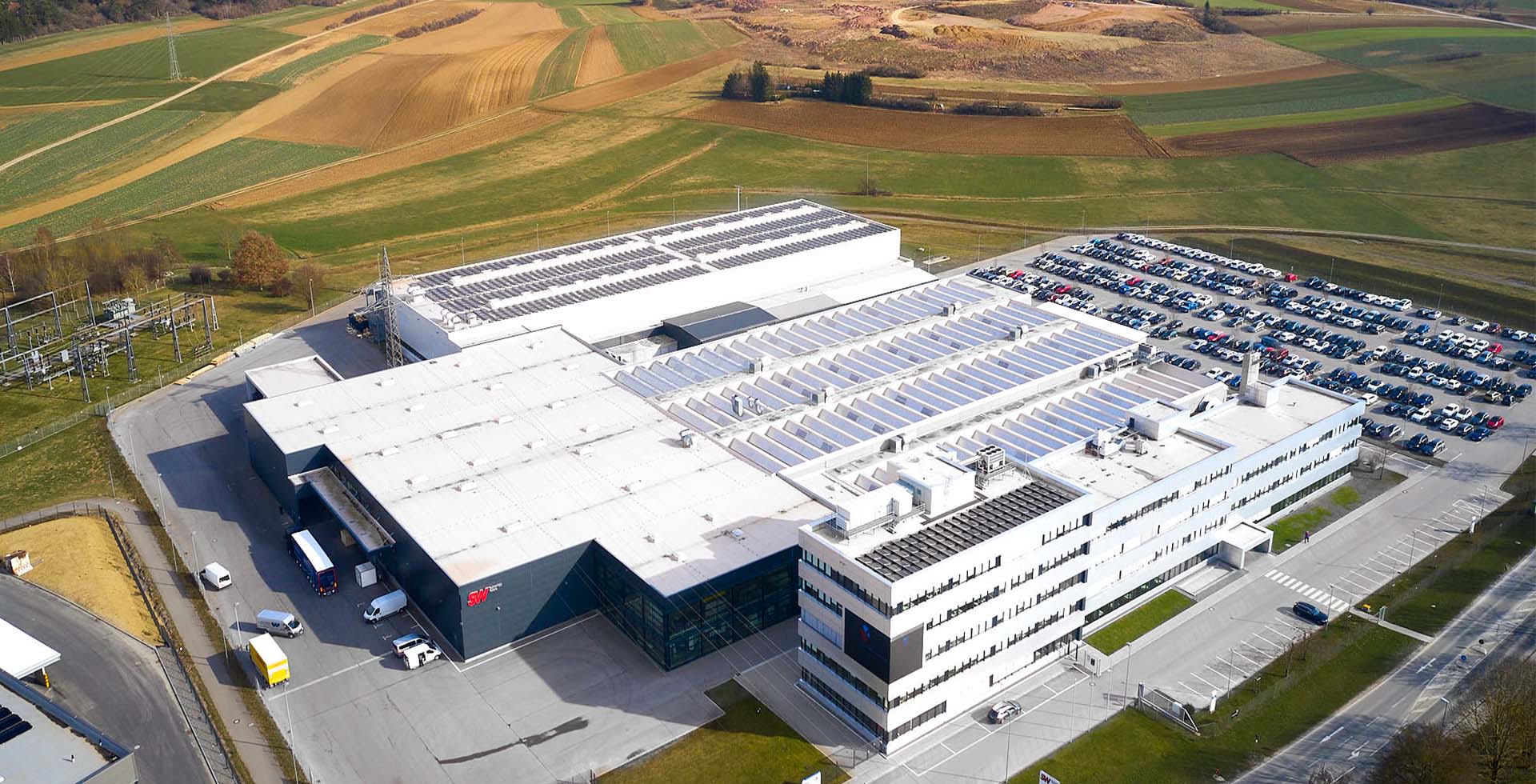
“Thanks to the order backlog from 2021 and the extremely high order intake in the first quarter of 2022, we have made a very good start to the current financial year,” says Markus Schmolz, Commercial Director of SW, reading off the latest figures. Headquartered in Waldmössingen, the company develops and produces high-precision machine tools with customized automation solutions. Growth is not a flash in the pan, but is driven by megatrends. “At least 70 percent of the parts manufactured on our new machines go into e-mobility,” calculates Stefan Weber, Managing Director Production & Technology at SW. “We also see great potential in this market in the future.”
In almost 30 years, SW has secured a firm place for itself worldwide as a supplier to automotive suppliers, the so-called Tier 1 and Tier 2. The company is traditionally regarded as a specialist for large-scale production of 10,000 parts or more per year. The special feature: The multi-spindle machine tools from SW produce up to four parts simultaneously with maximum precision. Components such as the ABS valve block for the brakes also have a future in electric cars. The situation is different for many hundreds of components that are currently required for combustion engines and gearboxes. For years, SW has been supporting suppliers with newly developed machines to set up additional production lines parallel to existing production, on which they initially manufacture components for electromobility in smaller quantities.
New machines for e-mobility at the right time
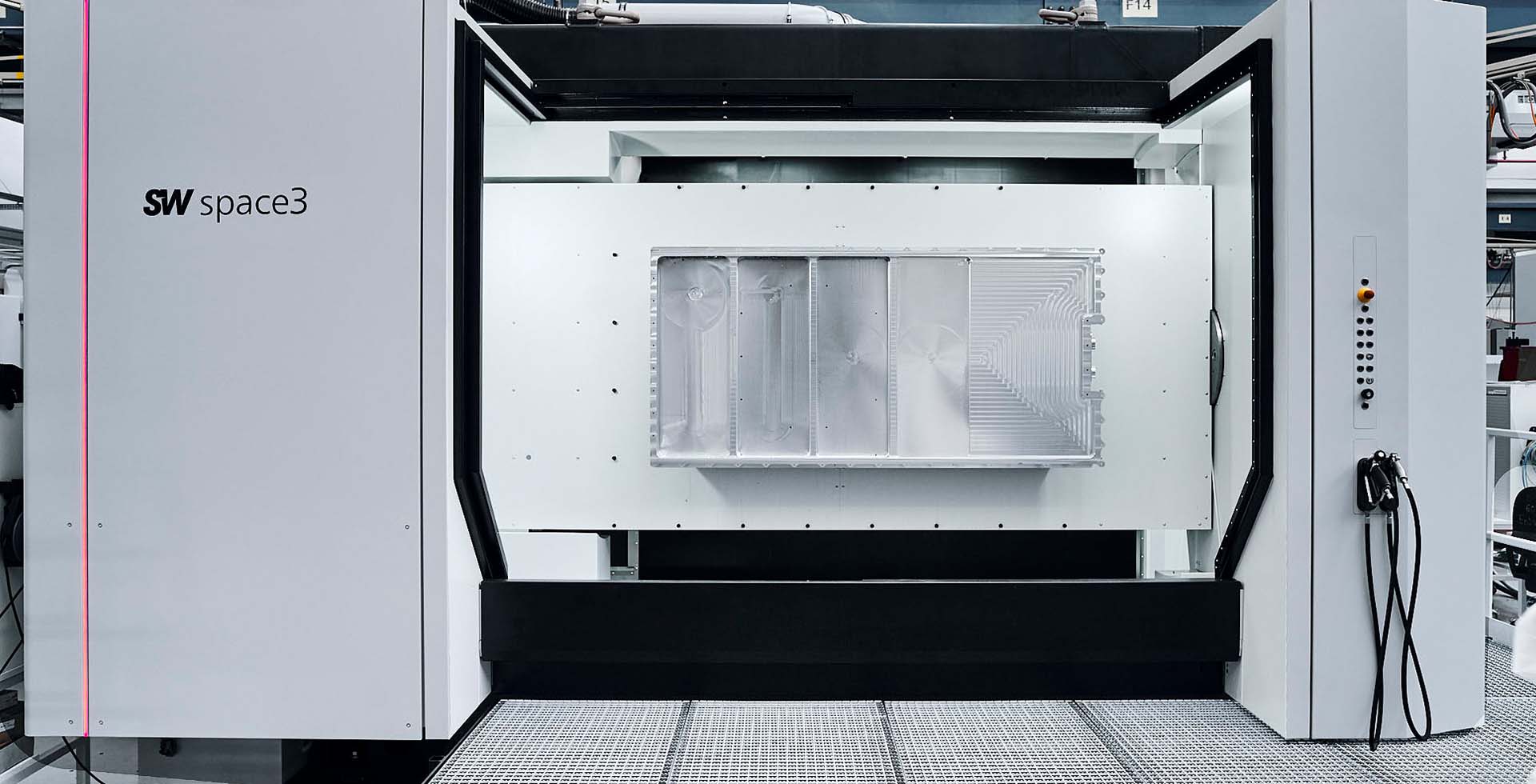
“Between the two axles, electric cars require complex battery housings that are up to two meters and longer,” says Stefan Weber, describing the challenge. That is why SW has developed machining centers that can process workpieces up to three meters long. “With electric cars, every kilo of weight saved increases the range, which is why manufacturers rely on light metals and alloys.” This also plays into SW’s hands, because in addition to a series of machines for machining steel and cast iron, the company has a complete family for machining non-ferrous metals in its range. “We were the first manufacturer to consistently focus on linear drives and therefore offer the fastest machining centers on the market,” says Weber. Every second saved in processing saves production costs.
One result: the supplier of battery housings for the Mercedes EQE and EQS series has worked with SW to implement the entire battery housing production process on an SW machine. “The component is technically very demanding and requires complex automation,” recalls Stefan Weber.
From machine supplier to system supplier
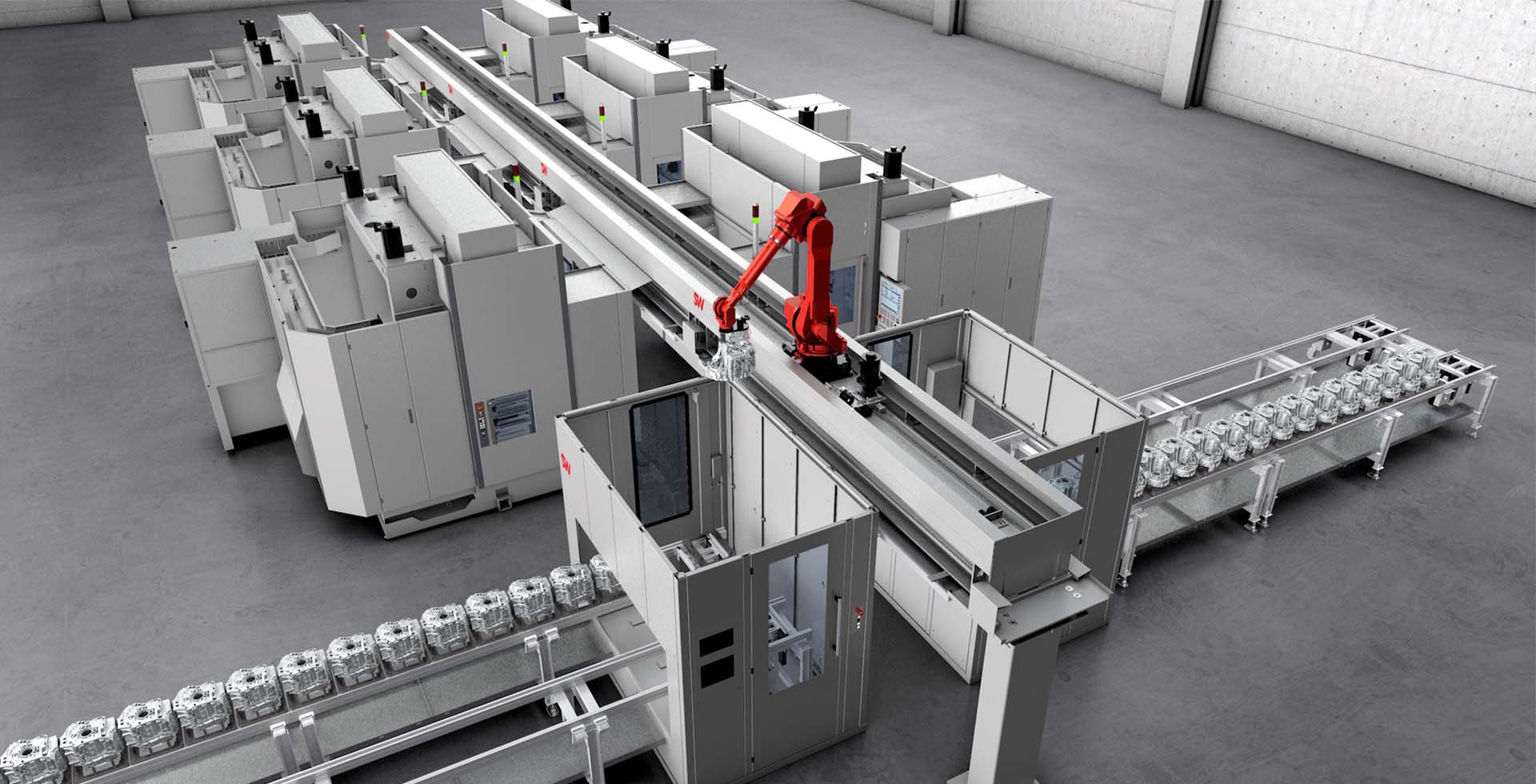
Around ten years ago, the management made the decision to offer more than just machining centers. “Our customers often don’t have the capacity to plan their production systems in detail themselves, program interfaces and coordinate different suppliers,” says Stefan Weber. In 2014, after several joint projects, SW therefore acquired the automation specialist bartsch in Tettnang, now SW Automation. “This allows us to offer our customers ready-to-use production solutions from a single source, from individual machines with integrated robots and workpiece storage to complete production lines with interlinked machines,” emphasizes the Managing Director of Production & Technology.
Configuring and commissioning such systems requires a great deal of expertise right from the planning stage. SW specialists can simulate the entire production process in advance, including the material flow and robot technology, and calculate the cycle times and even the subsequent unit costs. The trend is currently moving away from rigidly interlinked machines for high-volume production towards more flexible systems for smaller quantities. Entire component families with up to 20 variants can be produced fully automatically in SW’s flexible cells.
The newly developed single-spindle machining centers are increasingly being used for components of various sizes. They also cover batch sizes of less than 10,000 units per year economically. This is interesting for many newcomers to e-mobility, for example, who first have to build up production capacities for machining. You can start with a stand-alone cell for small series and then scale up production to larger quantities together with SW. However, industries such as medical technology also use these systems for the production of implants, surgical instruments or components for medical devices.
Digital business models
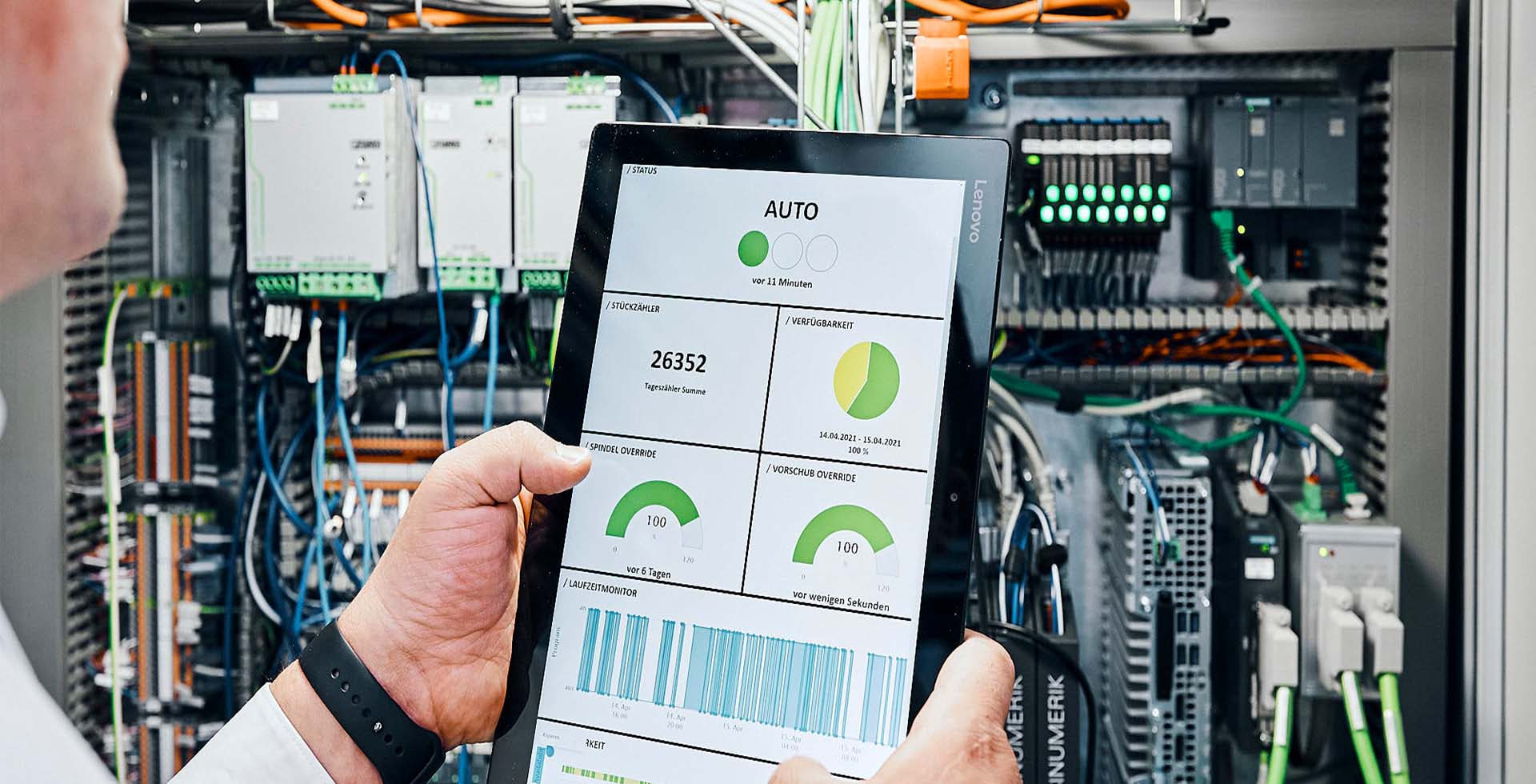
SW has been collecting and analyzing machine data from production and generating added value for customers since 2003, many years before the term Industry 4.0 came into use. More than 2,600 SW machines are now networked with SW’s Industrial Data Services (IDS). With the help of this operating data, the software specialists in the IDS department can, for example, optimize processes and ensure shorter cycle times. However, SW also ensures the traceability of components via the data: This is an increasingly important requirement. This allows manufacturers of cars or medical technology to track when and how components were processed on which machines at any time.
Another advantage, especially in recent years: In the event of problems, service technicians from SW can access the machines and robots via a secure connection and read out the error messages. They can rectify many faults from their workplace using software. This saves travel time and customers can return to production more quickly. “We are continuing to expand the IDS department, our interface between machine technology and information technology, and are continuously developing further digital business models,” confirms Stefan Weber.
Twenty-fold increase in sales – investment in training
The decisions have also proven to be economically correct. Started as a spin-off from the Heckler & Koch Group, SW began in 1995 with 125 employees (see box). Today, the company employs more than 1,200 technology people worldwide and has increased its turnover more than twenty-fold. The company has not cut any jobs during the pandemic, but has kept its core team on board. The company is also investing heavily in training the next generation of technology people. “We have a training quota of more than ten percent and train specialists in numerous professions,” emphasizes Markus Schmolz. To this end, SW will begin building a new training center at its headquarters in Waldmössingen next year. SW has also transferred the German training model to its plants in China and the USA. “We also actively promote the exchange of trainees and dual students,” says Markus Schmolz, explaining the international approach. Such an exchange has been established with the USA for several years and is firmly planned for China.
“We work in a very flat hierarchy and transfer responsibility quickly,” emphasizes the Commercial Director. “We all have a passion for technology and the ambition to offer our customers the best solutions, which is why we call ourselves Technology People,” he smiles.
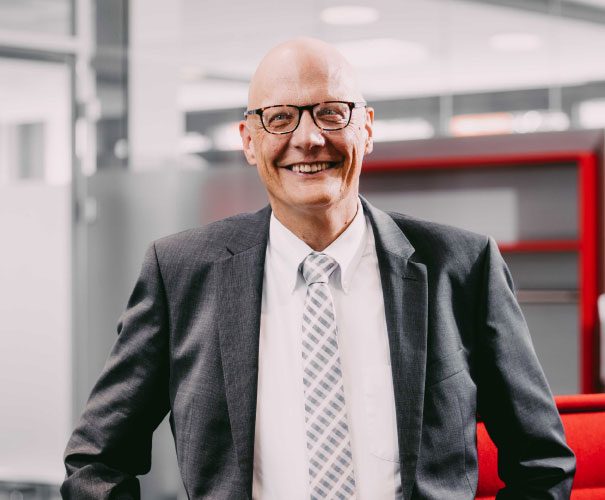
Markus Schmolz
Commercial Managing Director
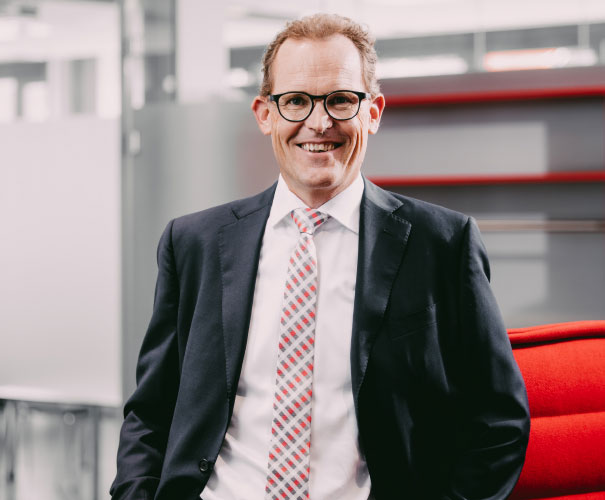
Stefan Weber
Managing Director Technology & Production
Glocalization: At home around the world
Even though the company headquarters on the edge of the Black Forest is not located in a metropolitan region, SW is a global player with an export share of more than 80 percent. Serving the large markets of Asia and North America from Germany alone cannot work in the view of the two managing directors. SW opened a production plant in Suzhou, China, back in 2016. Around 300 employees assemble machines and production systems there. The capacity of this plant is currently being doubled because SW is achieving the highest growth rates in Asia. The company has also set up a plant in the USA. “We talk about glocalization, we use the opportunity of global markets with local resources,” emphasizes Stefan Weber. Proximity pays off, as it allows SW to respond more flexibly to regional customer requirements and deliver faster thanks to local supply chains. SW has also established subsidiaries in Mexico, France, Italy, Poland and, most recently, Hungary, which serve local customers and meet regional requirements.
SW – The Leader in Smart Manufacturing Solutions
Even in the 28th year of the company’s history, SW remains on the move and wants to continue to change. The vision is: SW – The Leader in Smart Manufacturing Solutions. “We are moving even more consistently towards becoming a system supplier and digital service provider,” says Markus Schmolz, outlining the strategic direction. On the product side, the company is focusing on further expanding the modularity of the machines’ hardware and software. At the same time, SW is driving forward the digitalization and connectivity of its solutions and further expanding its digital business models. “Our success is shaped by the commitment and expertise of our employees,” emphasizes Stefan Weber. “We are focusing on sustainable growth through innovation and will expand our capacities once again with a new technology center here in Waldmössingen.”
