

It has long been integrated into the daily routine of most machine manufacturers at company level, but often remains elusive one level down: the carbon footprint. For many, the data required for a Product Carbon Footprint (PCF) is too inaccessible and unreliable, and the calculation for each individual product is too complicated and costly. The example of Schwäbische Werkzeugmaschinen GmbH (SW) shows how companies can nevertheless develop a scalable PCF for their product portfolio.

With an increasing global focus on sustainability and many corresponding regulations, the carbon footprint is also coming into focus in the mechanical engineering sector. However, while many machine manufacturers are already calculating their company-wide corporate carbon footprint (CCF) annually with a view to upcoming EU regulations, only a few are also looking at the product carbon footprint (PCF) – the footprint of all greenhouse gas emissions generated over the entire life cycle of a specific product. Although the calculation of the PCF is only mandatory in a few industries in the European Union, such as battery production, there is no way escaping it in the mechanical engineering sector in the long term – amongst others because many machine customers request the PCF of the equipment for their own CCF calculations.
On the other hand, there are a number of challenges that quickly make calculating the PCF for the entire product portfolio a mammoth task – especially for SMEs. One of the biggest problems is the lack of accurate data. To calculate a PCF precisely, the greenhouse gas emissions of each individual machine part must be evaluated and combined, from raw material extraction to transportation to production – or even beyond, depending on the selected system boundary. Companies need either primary emission data throughout the supply chain or at least correct and well-maintained master data to be able to use secondary data effectively. This data collection alone can take weeks or even months, especially in the mechanical engineering sector with its highly complex systems and parts lists.
However, even if all this data is available, the manual calculation of the PCF for the entire machine portfolio remains complex, time-consuming, and cost-intensive – not least due to a large number of different calculation bases and approaches: Are downstream processes in use and is disposal taken into account (cradle-to-grave), or does the calculation of the PCF end when the completed product leaves the factory boundaries (cradle-to-gate)? Which guideline should be used for calculation and reporting? And how can scaling from a single product to the product portfolio be achieved without having to manually calculate the emissions of each individual product?
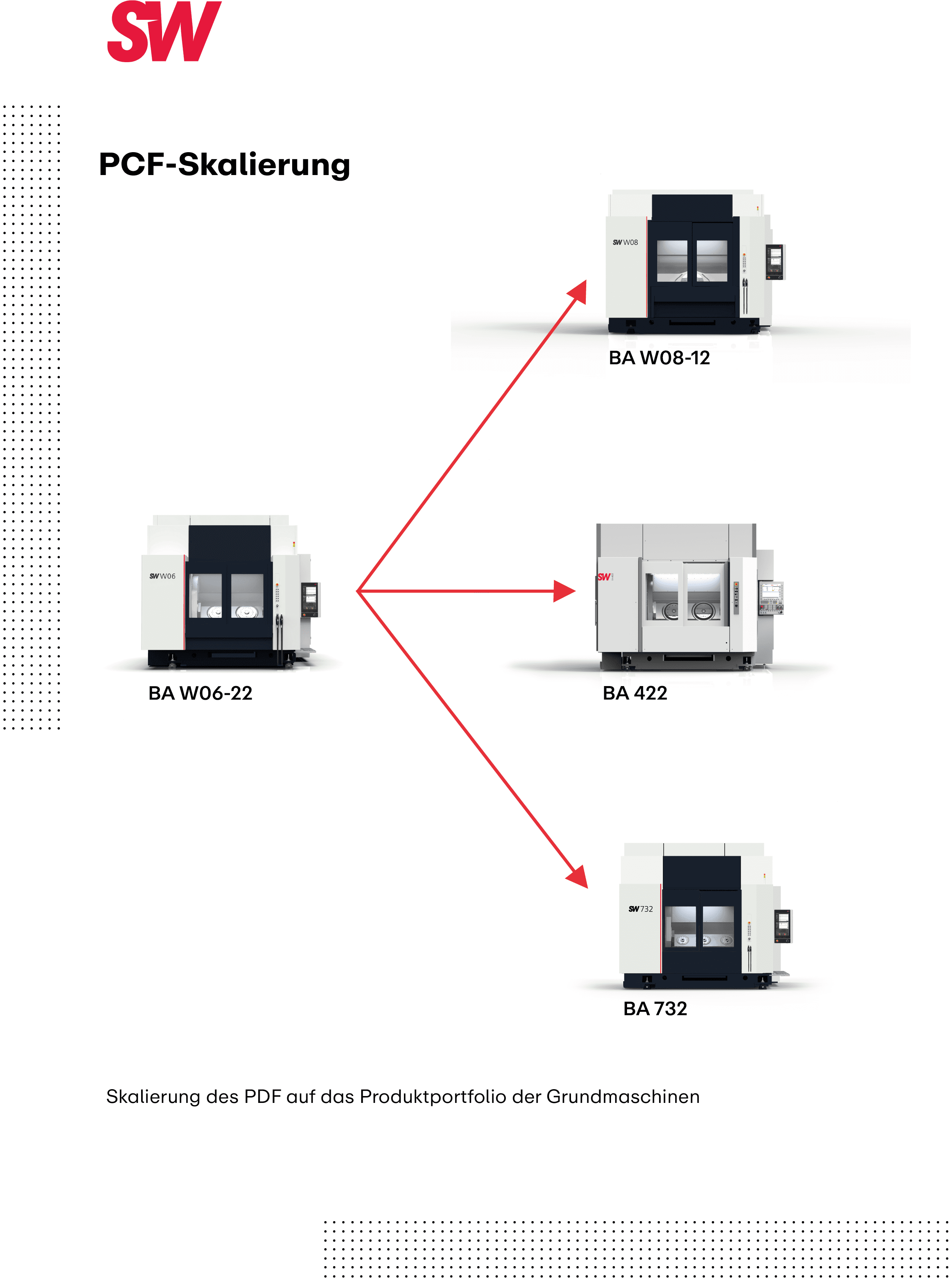
The basis: the right scaling approach
Schwäbische Werkzeugmaschinen GmbH (SW) shows that, despite these challenges, the PCF can also be implemented precisely and economically for machine manufacturers with a broad product portfolio. To be proactively prepared for future customer inquiries and to identify potential savings in its own greenhouse gas emissions, SW developed a calculation and scaling option for the product carbon footprint of its own machines. The result after just 10 weeks is a modular PCF calculator that outputs the carbon footprint for cradle-to-gate emissions of almost every machine configuration.
The first step towards this solution consisted in finding the right scaling approach. From dozens of calculation bases commonly used in science, SW chose the approach that best suited its own requirements in terms of accuracy and efficiency: the parametric PCF. This involves defining key parameters that differentiate the individual products in the portfolio from one another. The PCF of an initial product and the PCF with adjusted parameters are then calculated in order to establish a correlation between the considered influencing variables and the carbon footprint. Finally, this comparison serves as a basis for describing and calculating each additional product using the defined parameters.

One machine as a starting point
The most important factors influencing the PCFs of the SW machines were quickly identified: drive type, number of spindles, machine series, and number of machining stations. The BA W06-22, one of the company’s best-selling machines, was selected as the starting point for the calculation. The initial calculation was based on the product category rules “Machine tools and machines for additive manufacturing” (VDMA 34178) of the German Engineering Federation. This approach considers core elements with a particularly high CO2 intensity, such as the control cabinet and electric motors, separately from the rest of the machine. The emissions of the rest of the machine are then calculated in a simplified manner using the weight and the corresponding materials. Due to a lack of available primary data, SW mainly used secondary data for the corresponding emission factors and added an allocation of the corporate carbon footprint in accordance with VDMA specifications.
Fast scaling to all systems
In accordance with the parametric approach, SW determined the influence of changed parameters on greenhouse gas emissions for the scaling: For example, how do the weight and the materials change when comparing a ball screw drive with a linear motor, a higher number of spindles, or when using a double swivel bracket? This basis made it possible to calculate the change in carbon emissions for each individual parameter modification. Additional options such as a 5-axis bridge with an 8-fold rotary distributor were also calculated to cover SW’s entire product portfolio.
The results of all these calculations were incorporated into the development of a modular PCF calculator, which is extremely easy to use: For each machine, only the drive type, number of spindles, machining stations, and any additional options need to be selected. The calculator delivers the corresponding PCF as well as detailed information. A total of 37 basic machines or machine configurations can be calculated within seconds.

